
Origin story ·
LET'S GO: The Game AI Wasn't Supposed to Make
A twenty-year-old idea became a challenge: could enough context, clear direction, and AI build the calm infernal city builder I had always wanted?
AI cannot make a real game. AI is not creative. AI output is slop.
I had heard every version of the argument—especially in Germany and across Europe. AI this. AI that. A long list of reasons why the technology could imitate, but never create; produce, but never understand; assemble, but never make something worth playing.
Good.
Then let us find out.
If not now, when?
At the beginning of May, Pieter Levels' Vibe Coding Game Jam was still fresh in my mind. Its premise was wonderfully direct: ship an instantly playable browser game with at least 80 percent of its code, assets, and other components created with AI. People stopped debating AI-built games in theory and started shipping playful, surprising, genuinely cool results in public.
I loved it. I really wanted to take part.
But I could not. I had to focus on my own work, and there simply was no room for another project. Missing the jam hurt a little, because it showed me exactly the kind of experiment I wanted to run.
That unfinished urge stayed with me. I had spent months building and connecting MCP tools, AI workflows, and agents. They were no longer experiments that should live forever in a test environment. They needed a real project, real pressure, and a goal difficult enough to expose every weakness.
If I was ever going to discover how far this way of working could go, why wait? If not now, when?
August 31, 2025 · 5:00 PM: Let's go.
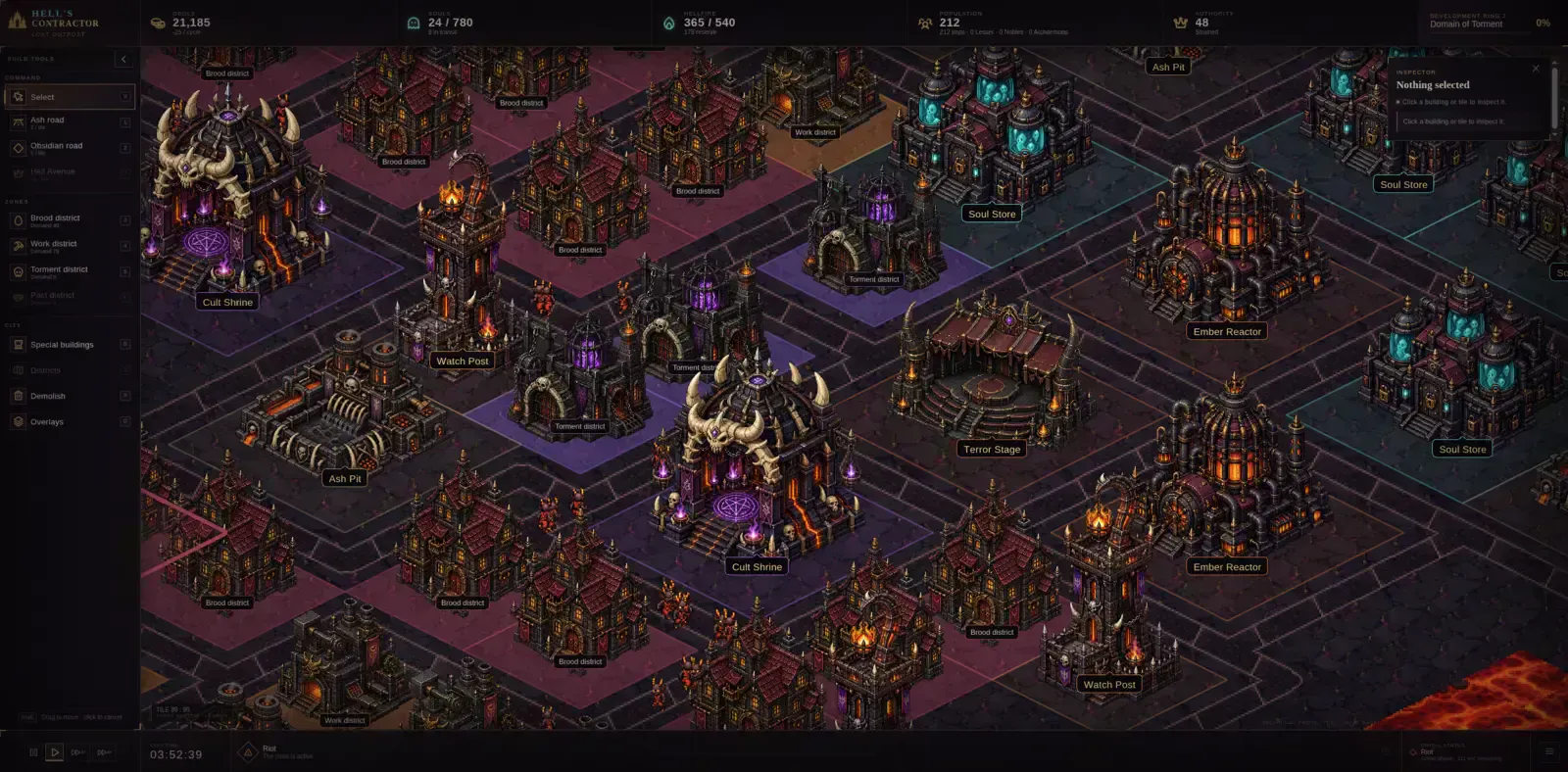
That was the moment I started Hell's Contractor.
There was no studio pitch, no finished design document, and no team waiting for a production plan. There was an idea I had carried around for roughly twenty years:
Wouldn't it be incredible to have a real city simulator set in Hell?
I wanted the systemic fascination of SimCity, the readable fantasy world-building of Warcraft, and the infernal atmosphere of Diablo—not as a copy of any of them, but as one original game about building and governing a living demonic city.
So I sat down with an AI and spent the first hour doing the work that would determine everything that followed: I explained what I wanted.
Context is everything
My hypothesis was simple: most disappointing AI output is not proof that AI cannot do the work. It is often proof that the task had no direction, no memory, no standards, and no meaningful context.
I did not ask, “Make me a game.” I described the kind of game, the world, the pace, the systems, the feeling, and the boundaries. I explained what the city should mean, how long one save should matter, what the player should be allowed to enjoy, and what the game must never become.
That first hour became a complete concept session. Not a magic prompt. Not a slot machine. A conversation with intent.

The quality of the answer depends on the quality of the world you give it to think inside.
That is the experiment behind Hell's Contractor: how far can AI go when it receives enough context, clear constraints, honest feedback, and a human who keeps steering?
The game I had wanted for twenty years
I did not want to build another disposable match, another city that exists only until a victory screen tells you to stop, or another game that constantly tries to hurry you into the next reward.
I wanted to build a city and decide what kind of place it becomes.
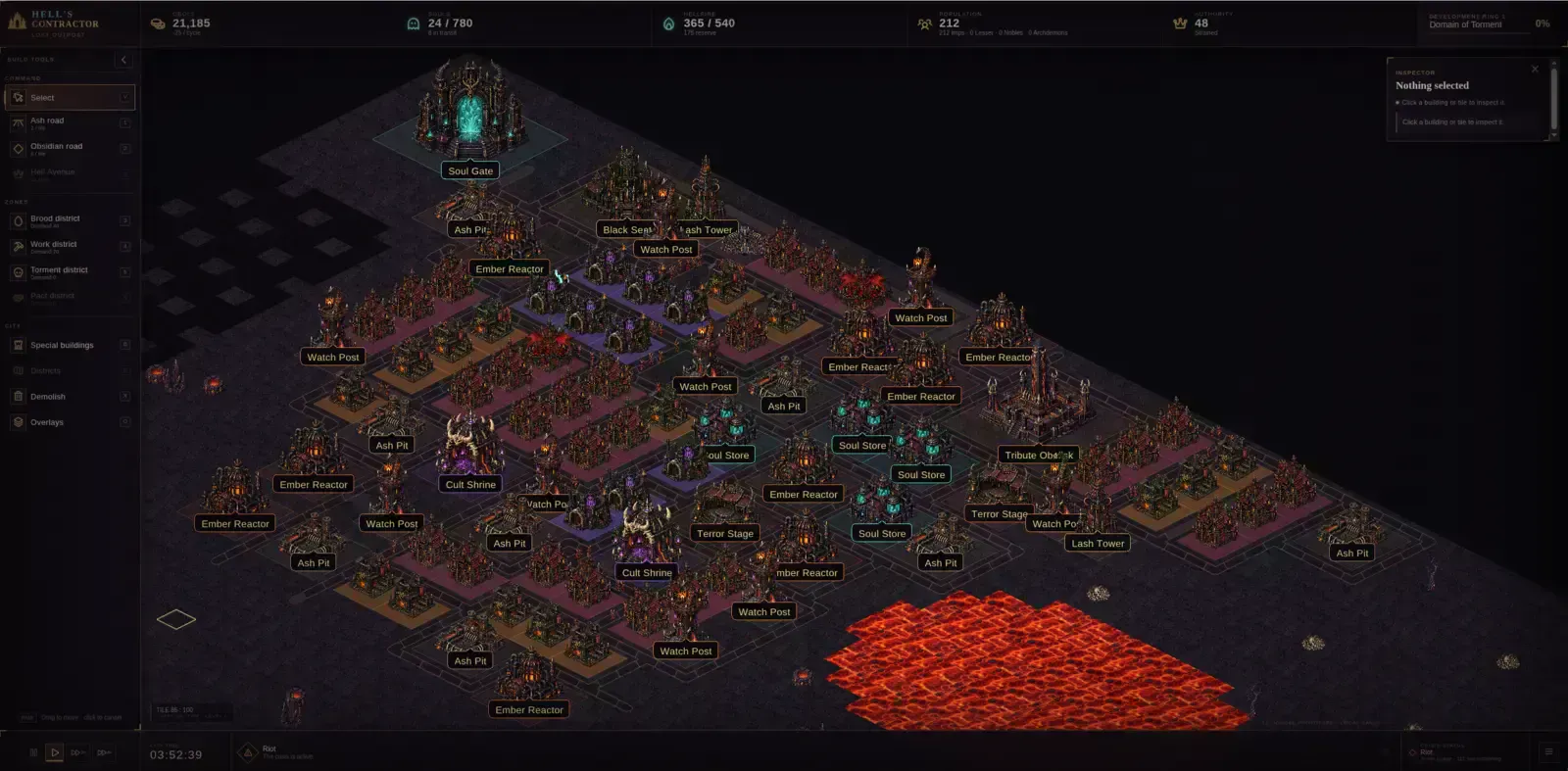
I wanted to watch its roads fill, see its districts grow, understand its problems, and occasionally pause just to enjoy the strange life I had created. I wanted to close the game, return days later, and simply continue.
In peace.
No fear of missing out. No pressure to keep up. No punishment because real life happened. No demand that every minute must be optimized.
More like LEGO: build, change, dismantle, improve, stare at it for a while, and then add one more piece because an idea occurred to you.
Hell's Contractor is meant to be played for the pleasure of building and tinkering. One city, many sessions, and no finish line pretending that the interesting part is over.
What the human still does
Let me make the uncomfortable part completely clear:
I have not personally programmed a single line of Hell's Contractor.
I directed the work. I supplied the context. I decided what the game should be, rejected what did not fit, corrected misunderstandings, tested the results, changed priorities, demanded consistency, and kept the project moving toward the experience in my head.
The AI wrote the implementation.
That does not mean the human disappeared. It means the human role changed. Taste still matters. Intent still matters. Judgment still matters. Knowing what to ask, what to keep, what to throw away, and when something is technically correct but creatively wrong matters more than ever.
AI did not arrive with a twenty-year desire to build a city in Hell. I did.
This project is not neutral about AI
Hell's Contractor exists to challenge the idea that AI-assisted work must be empty, careless, or disposable.
It will not convince everyone—and it does not need to.
If the use of AI alone is enough for you to dismiss a creative work, this project is probably not for you. The technology is not hidden here, softened into a footnote, or dressed up to avoid the discussion.
But if you see AI as a way to express thoughts that would otherwise remain trapped in your head; if you see it as a tool, a collaborator, or a new production language; if you are curious about what becomes possible when context and direction replace one-line prompts—welcome.
Welcome to the construction pit
Hell's Contractor has to prove two things at once.
First, it has to become the game I always wanted: a deep but calm city builder about logistics, class, growth, crises, and the joy of shaping a living infernal capital.
Second, it has to prove that the question is not simply whether AI “can make games.” The real question is what a person with a clear idea can build when the distance between imagination and implementation suddenly becomes much smaller.
This Chronicle will document that process honestly: the breakthroughs, the wrong turns, the systems, the art, the updates, and everything we learn while turning one impossible city into a playable one.
If that sounds exciting, write to me. Tell me what you think. Play the game, watch the city breathe, and enjoy what grows from this experiment.
Let's go.
Happy building. - Hen